
There’s an accelerating drive to innovate at the top of the global car industry. Tesla’s focus is on becoming the self-driving car leader, but it faces stiff competition at home and overseas.
The global automobile market is undergoing a major shake-up. It has been dominated by US players for decades, but the biggest name in car technology – Tesla – lost its crown earlier this year.
Having spent years as the world’s leading electric vehicle (EV) producer, Tesla fell behind Chinese rival BYD in 2025, delivering 1.64 million EVs compared to BYD’s 2.3 million.
Tesla’s EV delivery numbers have fallen for two consecutive years, but it may not trouble anyone at the company too much. As anyone who has been paying attention to its CEO Elon Musk knows, Tesla these days is much more focused on ‘autonomy’; essentially, physical forms of artificial intelligence (AI) like its humanoid ‘Optimus’ robots and, of course, self-driving cars.
So while Tesla’s EV numbers stuttered, 2025 was actually a great year for the company in terms of future innovation because of one key development: the long-awaited launch of its ‘robotaxi’ service. Initially limited (‘geofenced’) to Austin, Texas, the rollout means that Tesla has now begun to deploy the cars that it believes will truly change the world.
The only drawback? It is not the only company looking to put driverless cars on the road. It faces stiff competition, both from other domestic players and its Chinese nemesis, BYD.
Here, we’ll look at the global landscape for autonomous vehicle (AV) innovation, and explore why 2026 could be a groundbreaking year for the technology – especially for Brits.
Who are the biggest players in self-driving cars?
The most obvious competitor to Tesla is Google’s Waymo. It has the US’s largest fleet of robotaxis by some distance, with around 3,000 autonomous taxis operating in California (San Francisco Bay Area, Los Angeles and San Antonio), Arizona (Phoenix), Florida (Miami and Orlando) and Dallas and Houston in Texas. It is also available via Uber only in Austin, Texas and Atlanta, Georgia.
Waymo claims to have amassed 173 million miles of fully autonomous rides collectively with this fleet, giving it a mountain of data on which to train and improve its models. But many argue that Tesla’s vast fleet of human-driven cars will allow it to catch up rapidly with Waymo on this front.
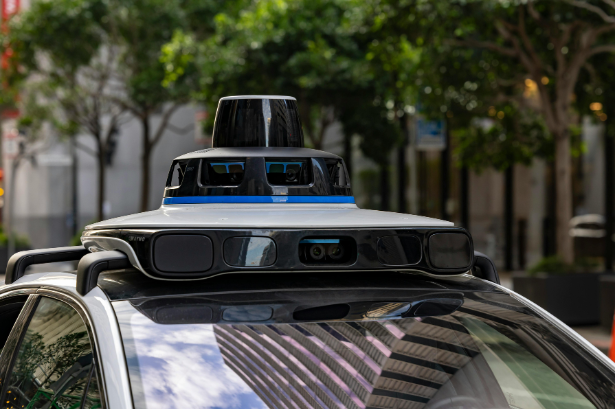
Additionally, there are technological differences between the two companies’ approaches to the way their AVs perceive the world around them. Waymo uses a bulky combination of 29 cameras, six radars and five LiDARs (which stands for Light Detection and Ranging and uses laser pulses to detect solid objects and measure the distance to them). Tesla, on the other hand, just uses eight cameras per car.
This makes Tesla robotaxis potentially far cheaper than Waymos (Musk once quipped that Google’s solution is “Waymo expensive” than Tesla’s), and Musk also maintains it makes them safer.
“If lidars/radars disagree with cameras, which one wins?” Musk posted on his social media platform X last year. “This sensor ambiguity causes increased, not decreased, risk. That’s why Waymos can’t drive on highways.”
But AV competition doesn’t begin and end with these two US tech giants.
As with EVs, Tesla’s AV business also faces competition from China. Baidu’s Apollo Go has been operating driverless robotaxi services in the country since 2022 and, like Waymo, has passed 20 million rides in recent months. Adoption is accelerating rapidly; Apollo Go provided three times as many rides in Q4 of 2025 as in the same period a year prior.
BYD is also making clear steps towards autonomous driving. Last February, it announced that nearly all its EVs would be equipped with autonomous driver assistance features, including automated navigation on motorways and self-parking via an app.
So the US firms won’t necessarily have it all their own way, and will have to continue to innovate at pace in order to stay ahead of international competition.
Could the UK make Wayves in AVs?
While the US and China appear to be in the driving seats of driverless car technology, don’t overlook the UK. It is home to a number of key innovators in the field, most notably Wayve, an embodied AI company building general-purpose driving intelligence.
In February, Wayve announced a $1.5 billion Series D that includes investments from tech giants Microsoft, Nvidia and Uber, as well as carmakers Mercedes-Benz, Nissan and Stellantis.
Wayve’s general-purpose driving intelligence is a significant development because it potentially moves self-driving cars away from being limited to a single city (geofenced).
“Autonomy will not scale through city-by-city robotaxi deployments alone,” said Alex Kendall, Wayve’s Co-Founder and CEO. “It will scale through a trusted platform that automakers and fleets can deploy globally and improve continuously.”
Within the last year, Wayve became the first company to power self-driving cars in over 500 cities globally (in Europe, North America and Japan) without them requiring city-specific fine-tuning first.

Source: Wayve.
Driverless cars are coming to the UK this year
As well as innovating in self-driving car tech, the UK could soon enjoy the technology first hand.
The BBC reported in January that driverless cars could be set to hit British roads as soon as September this year.
Waymo is due to launch a pilot service in London this April, and is already in the process of mapping the city’s streets, though it will need a change in the rules from the government to allow paying customers to take completely driver-free rides – expected in the second half of the year.
“We’re thrilled to bring the reliability, safety and magic of Waymo to Londoners,” said Waymo co-CEO Tekedra Mawakana. “Waymo is making roads safer and transportation more accessible where we operate. We’ve demonstrated how to responsibly scale fully autonomous ride-hailing, and we can’t wait to expand the benefits of our technology to the United Kingdom.
Might this be the year you take your first driverless taxi ride – or even, perhaps, your first step into a role innovating on AV technology?
If the latter, our team of experienced consultants can help connect you with the industry’s greatest innovators. Get in touch with our team today to find out more.